

Building an app with an AI-native platform typically costs $250 to $1,500 in year one for most founder projects, with a booking app or early SaaS MVP landing toward the higher end. The three line items that decide where you fall are the subscription tier you pick, how many build credits your project burns, and what you spend on hosting once real users show up. A hybrid model, part flat fee, part usage, is the default model worth planning around.
TL;DR:
- First-year costs for building an AI-native app generally range from $250 to $1,500, depending on project complexity and the chosen subscription tier.
- Build credit consumption is often underestimated, with typical costs between $100 and $500 for taking an idea to deployment, and overage charges can double expenses during heavy iteration.
- Budget for hosting separately from the subscription, as costs may spike once user traffic or storage surpass bundle limits, especially for SaaS MVPs.
- Hybrid models balancing a subscription floor with metered usage are the most sustainable, but if AI costs exceed 15-20% of revenue per user, margins could be at risk.
- Long validation phases for SaaS MVPs significantly increase costs due to ongoing credit consumption during repeated testing and feature rebuilding.
Table of Contents
- What Drives App Development Cost on an AI Builder
- Real Budgets: Simple App, Booking App, and SaaS MVP
- Choosing Between Subscription, Usage, Credits, and Hybrid Plans
- How to Estimate Your Own App's Cost
- How Adrian Labs Fits This Cost Model
- How Timeline Length Changes Your Total Cost
- Why Founders Should Know When to Graduate From a Builder
- Try Adrian Labs for Your Next App Build
- Sources
What Drives App Development Cost on an AI Builder
The subscription is your floor, not your ceiling. Entry plans commonly run $0 to $25 a month and cover a basic build environment; heavier "pro" or "business" tiers land between $25 and $200 once you need more concurrent projects, private repositories, or priority compute. You move up a tier when you outgrow the credits bundled into your current one, not before.
Build credits are the part founders underestimate. Every generation, edit, and deployment consumes credits, and overage pricing varies by platform, sometimes charged per action, sometimes rolled into a metered rate. One widely cited builder splits its pricing into a flat cloud fee plus tokens billed at cost, with typical spend to take an idea to a deployed app running $100 to $500 in tokens alone.
Hosting is where a cheap month can turn expensive fast. Some plans bundle hosting into the subscription; others bill your database and compute separately once traffic or storage crosses a threshold. Budget for the gap.
Then there's the supporting cast: a domain (roughly $10 to $20 a year), SSL (usually free through your host), uptime monitoring, and any third-party API you call. Set aside a maintenance buffer of 10% to 15% of your build cost for the first year.
- Subscription: monthly tier fee, scales with concurrency and compute priority
- Build credits: consumed by generations, edits, and deployments, with overage billed per action or metered
- Hosting and database: sometimes bundled, sometimes billed separately past a usage threshold
- Extras: domain, monitoring, third-party APIs, and a maintenance buffer
Statistic Callout: AI-native app builds commonly land in the $250 to $1,500 first-year range for common founder use cases, a fraction of what custom development typically costs.
Pro Tip: Check whether your builder counts a failed generation against your credit balance. Platforms that charge for retries as well as successes can quietly double your usage bill during heavy iteration weeks.
Real Budgets: Simple App, Booking App, and SaaS MVP
Numbers help more than ranges in the abstract, so here is how three common projects actually shake out over a first year.
A simple web app, think a landing page with a contact form and a lightweight dashboard, tends to stay near the bottom of the range. Expect an entry-tier subscription, light credit usage since you're not iterating constantly, and hosting that fits inside a bundled plan.
A booking app adds calendar logic and payment processing, both of which pull in third-party APIs and drive extra credit consumption during testing. Hosting costs also rise because you're storing more transactional data.
A SaaS MVP sees the most variability. Frequent iteration during early validation burns credits fast, and once you add a couple of integrations, your hosting and database costs climb with usage rather than staying flat.
| App type | Subscription (monthly) | Build credits (year one) | Hosting/database (year one) |
|---|---|---|---|
| Simple web app | $0–$25 | $100–$250 | Bundled to $25 |
| Booking app | $25 | $250–$500 | $100–$200 |
| SaaS MVP | $25–$200 | $250–$500 | $250–$1,500 |
A worked example: if your MVP burns 5,000 credits a month at $0.05 each, that's $250 monthly just in usage, before your $99 subscription. Three months of active iteration before launch pushes your build-credit line past $750, which is exactly why founders who skip this math get surprised by their first invoice.
Choosing Between Subscription, Usage, Credits, and Hybrid Plans
Pure subscription pricing is predictable but punishes light users and underprices heavy ones. Pure usage pricing tracks cost precisely but makes your bill hard to forecast month to month. Credit bundles sit in between: you prepay for a block of usage, which gives the platform predictable revenue and gives you a hard cap to plan around.
Hybrid pricing, a subscription floor plus metered usage on top, has become the most sustainable model for AI platforms because it balances predictability against the upside of capturing what heavy users actually consume. Lago's analysis of AI billing found that most mature platforms start usage-first, then layer in a subscription floor once they understand typical customer consumption.
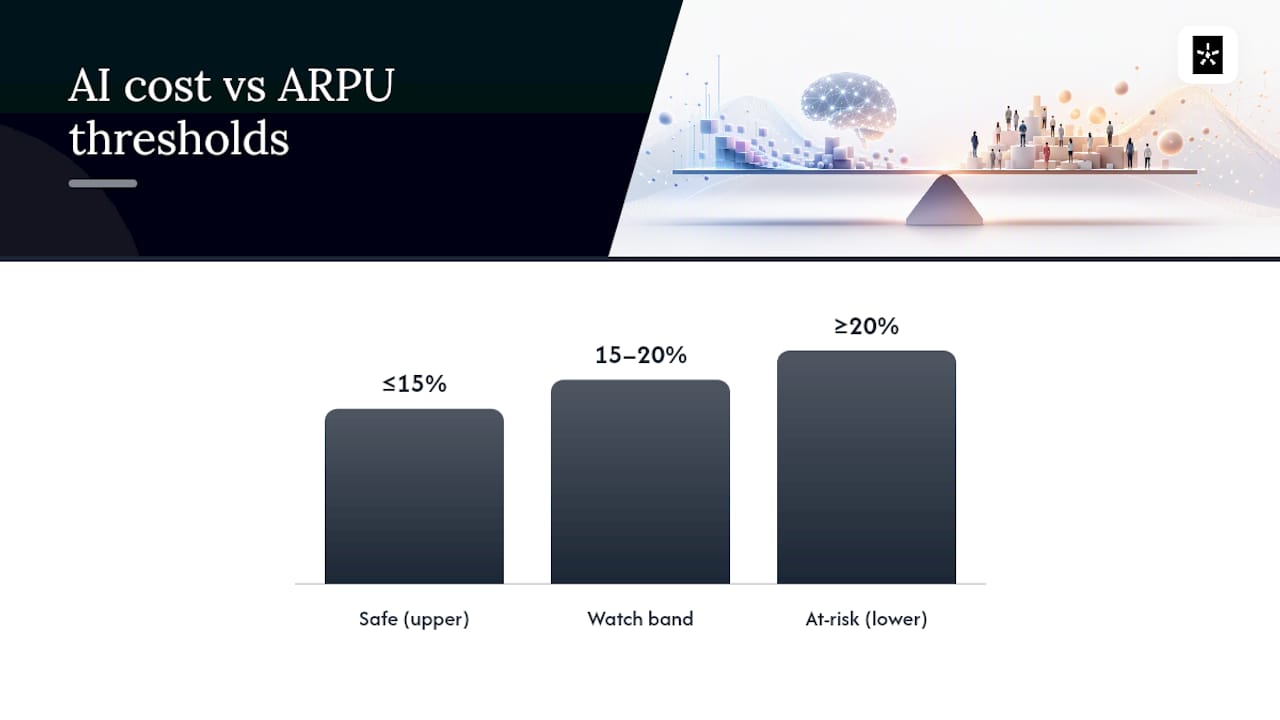
The math that matters here is cost per AI-active user against your average revenue per user. RevenueCat's guidance treats every AI feature as variable infrastructure cost, worth tracking the same way you'd track paid acquisition spend. If AI cost eats more than 15% to 20% of ARPU, your margins are at risk.
- Set a hard credit cap per billing cycle to prevent runaway usage
- Route non-critical generations to cheaper models where quality allows
- Cache repeated outputs instead of regenerating them
- Prepay credits in bundles rather than paying pure metered rates
How to Estimate Your Own App's Cost
Four steps turn assumptions into a number you can actually budget against.
- List every AI-triggering feature in your app and estimate the credit or token load per action. A chat response might cost less than an image generation or a full-page code edit.
- Estimate monthly active users and what percentage will actually trigger AI features. Most apps see 20% to 40% of users touch AI-heavy functions regularly.
- Apply a 2.5x buffer to your baseline credit estimate. Retries, heavy users, and edge cases consistently push usage above the naive average.
- Add fixed lines: subscription tier, hosting and database, domain, any third-party API fees, and a maintenance line.
That's 1,500 credits, or $75 a month, before the buffer. Apply 2.5x and you're at $187.50 monthly in credits, plus your subscription and hosting.
Pro Tip: Run this estimate before you build, then rerun it after your first month of real usage data. The gap between the two numbers tells you whether your assumptions about user behavior were right.
How Adrian Labs Fits This Cost Model
A certain AI app builder runs on a structured model with a subscription tier for advanced features, hosted build credits for generation and deployment, and a free desktop option that lets users run local models or bring their own API key to manage AI inference costs. That last part matters if you want to strip inference cost out of your monthly bill entirely, and the guide to running the builder locally walks through exactly how.
Bundled and separately billed features vary by plan, so check specifics before committing to a tier. Two posts go deeper than this article can: how Adrian builds an app, step by step covers the actual build process and where credits get spent, and what building with Adrian actually costs breaks down the bring-your-own-key option against the hosted subscription path.
- Subscription typically covers the build environment and advanced features
- Hosted agent usage usually draws from build credits, metered by generation and deployment
- Bring-your-own-key options route token costs directly to users' own API accounts
- Desktop apps with local models often remain free for non-paying use
Such platforms are useful for moving from an idea to a working, testable app without hiring a development team first.
How Timeline Length Changes Your Total Cost
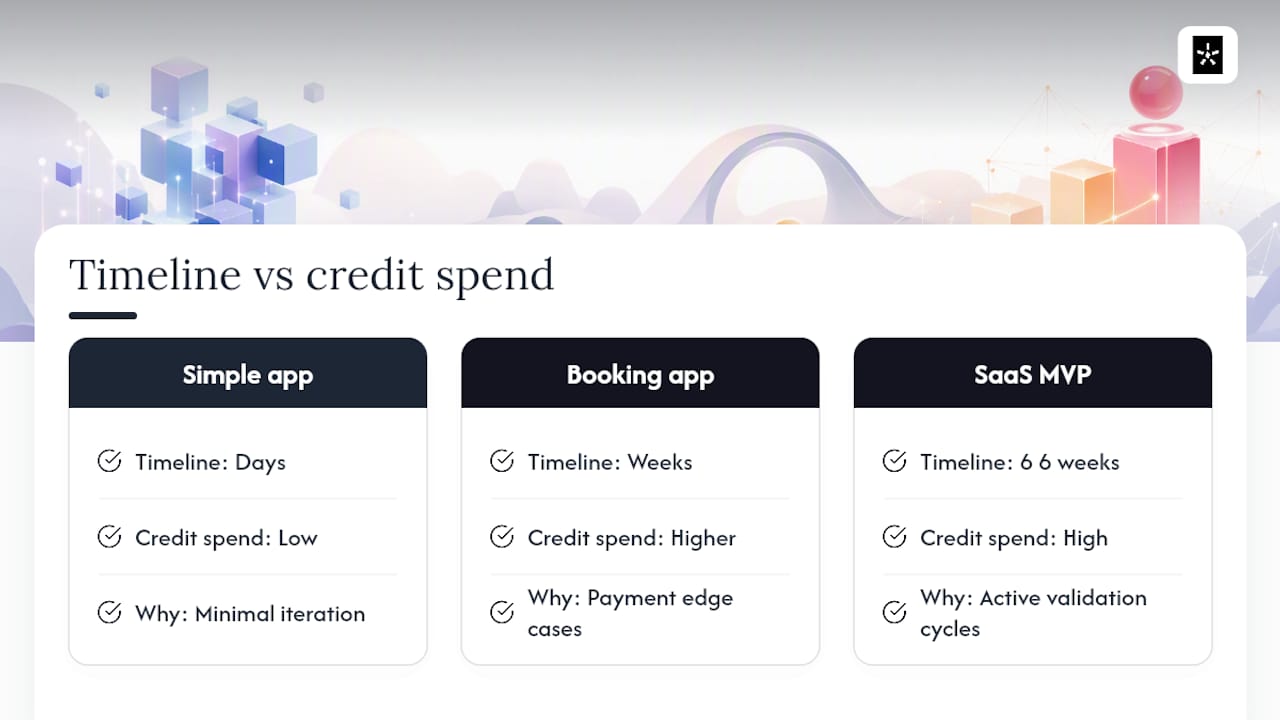
A simple web app built with an AI-native platform often reaches a usable version in days, not weeks, which caps your credit spend because you're not iterating for months. A booking app with calendar logic and payment integration usually takes longer to get right, mostly because payment edge cases need testing, and that extra iteration shows up directly in your credit line.
A SaaS MVP is the outlier. Founders validating a real market often spend six to twelve weeks in active iteration, testing features, cutting ones that don't land, and rebuilding ones that do. Every one of those cycles consumes credits, so a longer validation phase translates almost one-to-one into a higher build-credit total, even though your subscription fee stays flat.
The practical takeaway: timeline and cost aren't separate variables here the way they are in traditional development, where a longer timeline mostly means more billable hours. On a credit-based builder, timeline length is largely a proxy for how much you're regenerating and re-testing. Founders who scope tightly before they start, deciding what the MVP actually needs to prove, tend to spend less simply because they iterate less. That's a planning problem, not a pricing problem, and it's the one lever entirely within your control before you write a single prompt.
Why Founders Should Know When to Graduate From a Builder
Founders lean on AI-first builders because validation speed beats perfection early on. You're testing a hypothesis, not building infrastructure for scale.
Custom development earns its cost once you hit real scale, need a critical third-party integration a builder can't handle cleanly, or face compliance requirements that demand tighter control over your stack.
Before that point, ownership matters most: confirm you can export real, working code. A platform that locks you in erases the flexibility that made the builder worth choosing in the first place.
— Adrian
Try Adrian Labs for Your Next App Build
Adrianlabs turns the cost model in this article into something you control directly. Instead of guessing at developer hours or agency retainers, you describe your app in plain language and watch Adrian plan, code, and preview it live, with your spend tied to a subscription and build credits you can track as you go.
If you want to see exactly where your code lives and how deployment works before you commit, start with the breakdown on where your code actually goes when you build with AI. For founders modeling their broader unit economics, the reconciliation approach in this guide to blended CAC pairs well with the ARPU math from the pricing section above.
Ready to see your own numbers instead of estimates? Visit Adrian's platform page and start building your first version today.
Sources
For deeper unit economics, see the BVP pricing playbook, Lago's hybrid model analysis, and RevenueCat's margin guidance.