
An autonomous coding agent is a headless system that plans a task, edits code across files, runs tests, and produces a reviewable pull request instead of a line suggestion. It differs from editor assistants by working asynchronously on whole tasks, not single keystrokes. For most teams, the right move is treating it as infrastructure: powerful for routine engineering work, but only when paired with verification gates, sandboxing, and a review-first merge process.
TL;DR:
- Running multiple autonomous agents in production requires a control plane for configuration, visibility, and shared rules to maintain consistency.
- Sandboxing with ephemeral containers and local memory stores are crucial for safe, reproducible, and context-aware automated code generation.
- Higher levels of autonomy increase throughput but reduce oversight, making it essential to keep humans involved in security-critical or legacy code tasks.
- A strict, phased workflow with verification gates ensures that agent-generated code is thoroughly tested, reviewed, and safe before merging.
- Starting with small, controlled pilot projects and full PR reviews is the safest approach to integrate autonomous coding agents into existing workflows.
Table of Contents
- What is an autonomous coding agent, and how does it differ from editor assistants?
- How do teams architect agents safely: control planes, sandboxes, and memory?
- What are the levels of autonomy, and what trade-offs come with each?
- How should engineering teams govern agent output in production?
- What do real agent implementations and open-source projects look like?
- How does Adrian Labs fit into this dev-lifecycle approach?
- Author perspective: practical recommendations and adoption pitfalls
- Ready to Pilot an Agent-Driven Workflow?
- Sources
What is an autonomous coding agent, and how does it differ from editor assistants?
The unit of work is what separates an autonomous coding agent from the autocomplete tools most developers already know. An in-editor assistant like GitHub Copilot suggests the next line or function while you type, staying inside your feedback loop. An autonomous coding agent works at a different scale entirely: you hand it a ticket, a bug report, or a scoped feature request, and it goes off to plan the change, edit multiple files, run the test suite, and come back with a pull request. You're not watching it type. You're reviewing its output hours later.
That asynchronous model changes what the tool is actually good for. Editor assistants excel at reducing keystrokes on code you're already writing. A software engineering agent excels at taking a defined task off your plate entirely, working through it while you're in a meeting or asleep, and surfacing the result as something a human can approve or reject.
Here's what that capability set typically looks like in practice:
- Multi-file reasoning: the agent traces a bug or feature across a codebase's actual file boundaries, not just the open tab.
- Test-run loops: it executes the project's real test suite, reads the failures, and iterates before declaring the task done.
- CI interaction: it can trigger, read, and respond to continuous integration results as part of its own workflow.
- PR creation: the final artifact is a diff with a description, not a chat transcript.
The failure modes are just as important to understand upfront. Agents tend to struggle with tasks that require judgment calls that are not documented anywhere in the codebase, tasks touching poorly tested legacy code, and tasks where the "correct" behavior depends on tribal knowledge. Scaffolding, well-specified bug fixes, and mechanical refactors are where an autonomous coding agent earns its keep. Ambiguous product decisions are not.
How do teams architect agents safely: control planes, sandboxes, and memory?
Running one agent on a side project is trivial. Running several agents against a production codebase without burning through your CI budget or leaking credentials requires actual architecture. Four patterns show up repeatedly among teams doing this well.
A control plane ties everything together. Rather than configuring each agent run from scratch, teams use a one-config approach, an agent console for visibility, and shared rules that every agent instance inherits. AI DevKit's control-plane model demonstrates this directly: one configuration file, a console for cross-agent visibility, and composable skills that enforce the same engineering discipline whether one agent or five are running against the repo.
Isolated execution keeps agents from touching your host machine directly. The dominant pattern is ephemeral containers or cloud VMs spun up per task and destroyed afterward. Loopyard's approach sets up Docker Compose environments so agents run in reproducible, disposable sandboxes rather than a shared development machine that accumulates drift.

Memory retrieval solves a subtler problem: context bloat. Feeding an agent your entire codebase history on every run wastes tokens and slows reasoning. Teams instead use local SQLite databases or lightweight vector stores to retain project conventions, past decisions, and style rules, retrieving only what's relevant to the current task.
Integrations round out the stack: repo-scoped access tokens instead of full credentials, CI hooks that the agent can read but not override unilaterally, and logging that captures every command the agent executed for later audit.
- Control plane: one config, shared rules, cross-agent console
- Sandboxing: ephemeral containers or cloud VMs per task
- Memory: local stores for conventions, not full-history context
- Integrations: scoped repo access, CI hooks, audit logging
Pro Tip: Delete and re-run the container instead of debugging a broken agent session. If the sandbox is truly ephemeral, a failed run costs you minutes, not a corrupted dev environment.
What are the levels of autonomy, and what trade-offs come with each?
Not every task deserves the same amount of agent independence. A useful taxonomy runs from assistive to fully autonomous, and picking the wrong level for a given task is where most bad outcomes start.
- Assistive: the agent suggests code inline, similar to standard AI coding assistant tools. A developer accepts or rejects each suggestion in real time. Oversight is continuous.
- Conversational: the agent discusses an approach with a developer before touching code, refining a plan through back-and-forth. Oversight happens before execution.
- Task agent: given a scoped ticket, the agent works independently, runs tests, and returns a PR for review. Oversight happens after execution, at the merge gate.
- Autonomous teammate: the agent handles a queue of tasks with minimal per-task check-ins, escalating only on failure or ambiguity. Oversight is periodic and process-level rather than task-level.
Each step up that ladder trades oversight for throughput. A task agent finishes far more work per day than a conversational assistant, but you lose the ability to redirect it mid-thought. An autonomous teammate handles volume well, but explainability drops. When something goes wrong three tasks deep in a queue, tracing the root cause takes real audit-log discipline.
The practical guidance: adopt higher autonomy for well-tested, well-documented parts of the codebase where a wrong answer is cheap to catch. Keep humans tightly in the loop for anything touching security, billing, or undocumented legacy logic, regardless of how capable the agent seems on paper.
How should engineering teams govern agent output in production?
Ad-hoc prompting produces ad-hoc results. Practitioners running agents at scale consistently report that structured, phase-based engineering discipline is what separates predictable output from a pile of half-working diffs.
The workflow that holds up in practice runs through six phases, each producing an artifact a reviewer can inspect: requirements, design, plan, implement, test, review. Skipping straight from requirements to implementation is exactly how agents produce code that compiles but doesn't actually solve the problem, a failure mode common enough that it's worth reading about directly.
Verification gates are non-negotiable at this stage. No agent-generated change merges without a green test run, and a human reviews the diff before it lands. Agent-first tools have converged on this exact pattern: Agentcode plans edits, runs the project's actual test suite, and opens a pull request with passing results rather than merging on its own authority. That review-first PR model is what makes agent adoption politically survivable inside an engineering organization, not just technically feasible.
Composable skills embedded directly in the agent's workflow, things like TDD enforcement, structured debugging, and automated security review, materially cut down on flaky or unsafe output by forcing artifact-level checks before a task counts as complete, according to AI DevKit's design.
Operational controls round out the governance layer:
- Approval rules that require explicit sign-off for changes touching auth, payments, or infrastructure
- Rate limits capping concurrent agent tasks per repo
- Auto-retry caps so a stuck agent doesn't loop indefinitely and burn compute
- Retention of full agent logs for post-incident auditing
Coverage of tools like Cursor's web app for managing agents reflects a broader shift: agent tooling is moving from experimental scripts to production infrastructure, and that shift is precisely why governance tooling has become a market of its own rather than an afterthought.
What do real agent implementations and open-source projects look like?
The architecture and workflow patterns above aren't theoretical. A handful of projects show what each piece looks like when actually built.
Control-plane thinking shows up clearly in AI DevKit, which pairs a single configuration file with an agent console so a team can watch what multiple agents are doing against the same repo without digging through separate logs for each.
Sandbox-first design is the whole premise behind Loopyard, which sets up ephemeral, Docker-based dev environments specifically so an agent's mistakes stay contained to a disposable container. If a run goes sideways overnight, the fix is deleting the container and re-running, not forensic debugging of a shared machine.
PR-first agents are best represented by Agentcode, which runs the actual test suite before presenting a diff, and by hosted tools like Jules, which ties agent runs to cloud VMs with defined task and concurrency limits rather than unlimited background compute.
Community projects add another layer worth studying. Forge Agent implements persistent memory, task templates, and a security sandbox specifically so autonomous runs don't need direct access to host credentials, a detail that matters more than it sounds once you're running unattended overnight jobs.
The lesson across all of them: instrumentation and rollback aren't optional extras bolted on after the fact. They're the difference between an experiment and something you can actually trust with production code.
- One-config control planes for multi-agent visibility
- Ephemeral, container-based sandboxes for reproducibility
- Real test-suite execution before any PR gets opened
- Persistent memory and sandboxed credentials for unattended runs
How does Adrian Labs fit into this dev-lifecycle approach?
Some platforms build governance patterns directly into their workflows rather than treating them as optional add-ons. These platforms handle planning, full-stack code generation, autonomous debugging, and project isolation as part of a single pipeline, with releases verified for integrity before shipping. That maps closely to the phase-based discipline described above: plan, implement, verify, review.
For teams evaluating whether to bring an agent into an existing codebase, the safer path is a small pilot rather than a full rollout:
- Connect a single, non-critical repository first
- Set strict approval rules requiring human sign-off before any merge
- Run two or three well-scoped pilot tasks, nothing touching auth or billing yet
- Require full PR review on every output before it lands
You can read more about how code ownership and quality controls work inside Adrian's process, including where generated code actually lives and how verification happens before a release goes out.
Author perspective: practical recommendations and adoption pitfalls
The teams that get burned by agents almost always skipped the boring part: scoping tasks tightly and refusing to merge anything without a green test run. Treat an agent config the same way you'd treat infrastructure code, versioned, logged, and monitored, not a one-off prompt you tweak until it works. Humans still own merges and design calls. Say that out loud to your reviewers before the first pilot, not after the first bad merge.
— Adrian
Ready to Pilot an Agent-Driven Workflow?
If reading through control planes, sandboxing, and verification gates left you wanting something that already builds those controls in rather than something you'd have to assemble yourself, some platforms aim to close that gap. They allow you to describe the app you want in plain language, then handle planning, full-stack code generation, autonomous debugging, and project isolation as one connected pipeline, with releases checked for integrity before shipping.
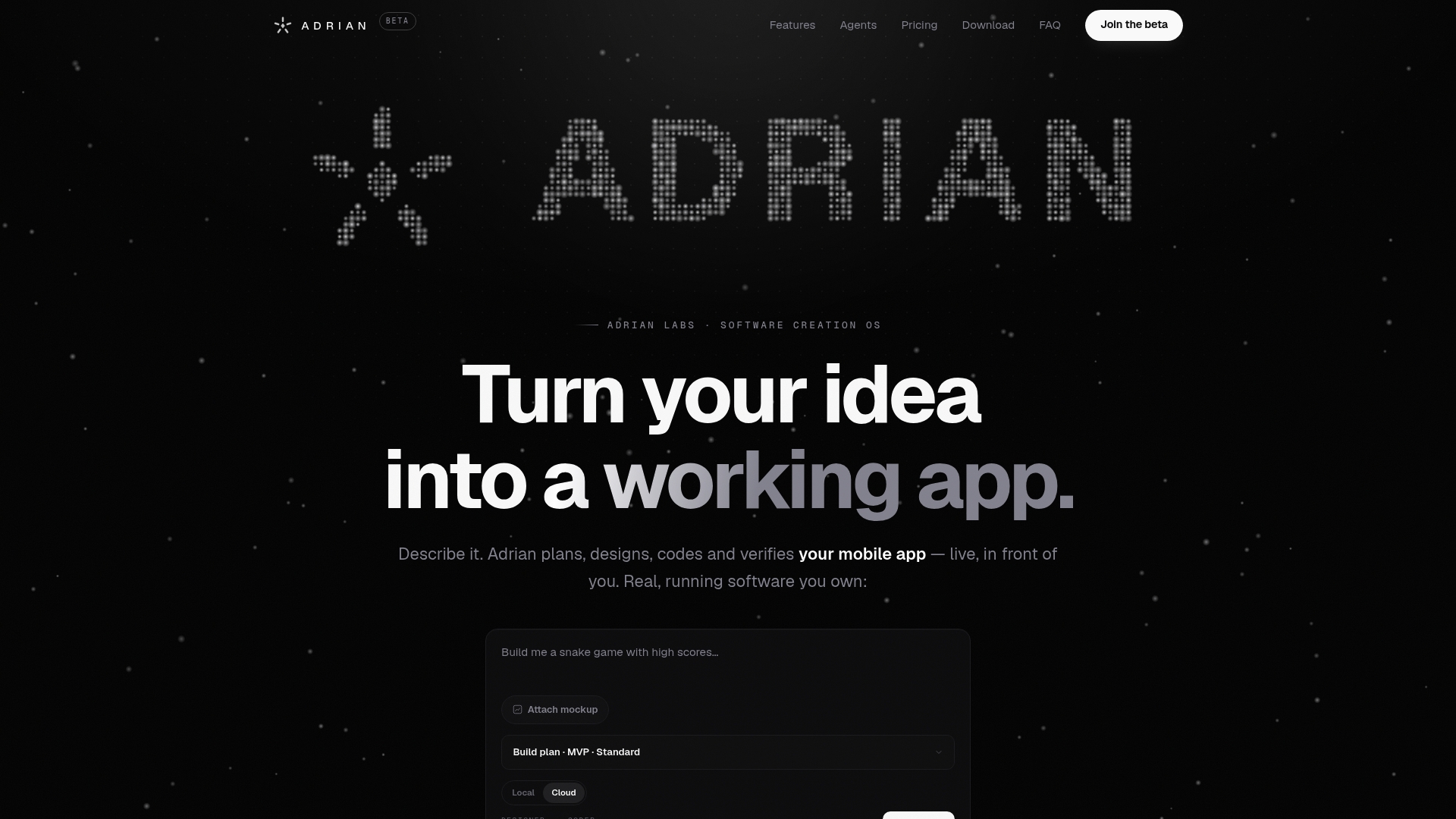
Some platforms offer privacy controls over how code and prompts get handled, supporting running with local models or user-supplied API keys, so nothing has to leave your machine if that is a requirement. The practical next step: connect one low-risk repository, scope two or three pilot tasks, and require full PR review before anything merges. Start that pilot on the Adrian Labs platform and see how the generated pull requests hold up against your own test suite before expanding scope.
Sources
- AI DevKit — control plane for AI coding agents
- Loopyard — agents that set up and run your dev environment
- TechCrunch — Cursor launches a web app to manage AI coding agents