
Buy the context, build the core. That is the rule now, and it hasn't fundamentally changed, but the math behind it has: AI coding tools have cut internal build estimates for common workflows by 60 to 80 percent, which means capabilities that used to be automatic "buy" decisions now deserve a second look. The single constraint that should decide your next move is time-to-market, not sticker price. Run the scoring matrix below before you sign anything.
TL;DR:
- AI coding tools have reduced build time estimates by 60 to 80 percent, making custom development more competitive in many scenarios.
- Building is especially advantageous when the capability is core to differentiation, long-term ownership is feasible, and customization is critical.
- Buying is ideal for commodity functions requiring rapid deployment, standardized compliance, and predictable updates, despite potential long-term cost increases.
- A hybrid approach often yields the best results by outsourcing core infrastructure and building custom interface or differentiating layers on top.
- Conducting a quick 30-day decision sprint and using a weighted scoring matrix can clarify whether to build, buy, or hybridize based on specific organizational needs.
Table of Contents
- Build vs Buy Software Decision: A Scoring Matrix You Can Use Today
- When Building Wins: Control, Ownership, and What It Costs You Later
- When Buying Wins: Speed Now, Costs Later
- The Hybrid Approach: Buy the Plumbing, Build the Edge
- What Does Build vs Buy Actually Cost Over Three Years?
- How Do You Evaluate Vendor Risk Before You Sign?
- Can You Decide Build vs Buy in 30 Days?
- How AI-Native Platforms Change the Math
- What Product Leaders Get Wrong About This Decision
- Build Your Own Software Without the Six-Month Timeline
- Where the Numbers in This Framework Came From
- Sources
Build vs Buy Software Decision: A Scoring Matrix You Can Use Today
Every build vs buy software decision comes down to eight criteria, and most teams skip half of them because they're in a hurry to get a vendor demo on the calendar.
Score each criterion from 1 to 5, where 5 strongly favors building and 1 strongly favors buying:
- Competitive differentiation — Does this capability directly shape why customers choose you over a competitor? A logistics company's routing algorithm scores a 5. Its expense-reporting tool scores a 1.
- Customization depth — How far does your actual workflow deviate from a standard implementation? Heavy deviation pushes the score toward build.
- Integration complexity — Will this system need to talk to five internal databases and two legacy tools that no vendor has ever heard of? That complexity often favors a custom layer.
- Time-to-market pressure — If you need something live in six weeks, buying (or an AI-assisted build) usually wins over a from-scratch build.
- Internal expertise — Do you have engineers who understand the domain, or would you be hiring from zero? No in-house expertise is a strong signal to buy.
- Regulatory requirements — Highly regulated data handling (health records, financial transactions) sometimes favors building so you control the compliance surface directly, though it can just as easily favor a vendor who has already passed the audits.
- Data sensitivity — Where does the data live, who can see it, and does a third-party processor introduce risk you can't accept?
- Vendor dependency risk — If this vendor doubles its price or gets acquired in year two, how exposed are you?
Weight these differently depending on your company stage. A startup building its first product should weight time-to-market and internal expertise heavily, because a six-month delay can be fatal. A scale-up should weight differentiation and integration complexity higher, because it's past the "does this work at all" stage and into "does this give us an edge." An enterprise typically weights regulatory requirements and vendor risk hardest, because a bad vendor bet at that size can cost millions to unwind.
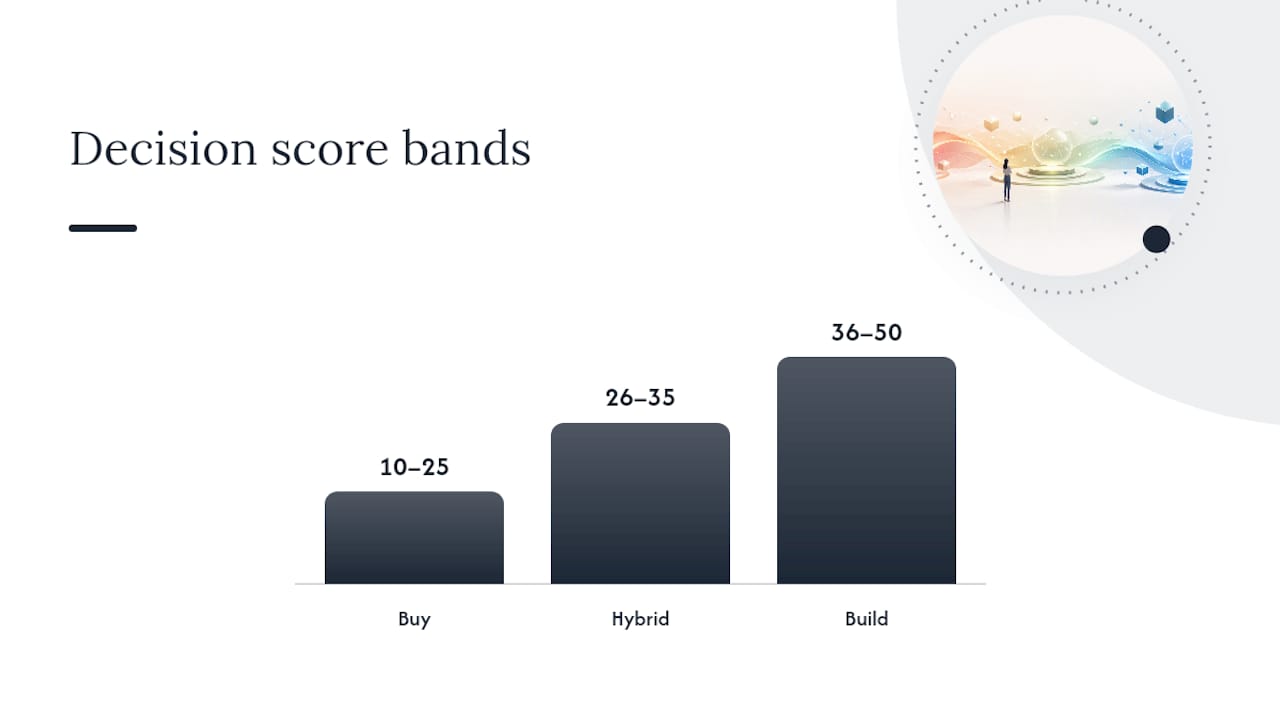
A weighted scoring matrix across these eight criteria produces a total score you can map to a recommendation. One useful version of the rubric: totals in the 10 to 25 range point to buy, 26 to 35 suggest hybrid, and 36 to 50 point toward build. The exact numbers matter less than the discipline of scoring each criterion separately instead of making a gut call after one vendor pitch.
Pro Tip: Run this matrix with at least two people scoring independently before comparing notes. A single decision maker's score is usually skewed by whichever option they already like.
Re-run the matrix annually, or immediately after any major vendor pricing change or internal reorg. Scores that justified buying in year one often shift once your team has grown enough internal expertise to own the capability, or once a vendor's roadmap drifts away from what you actually need.
When Building Wins: Control, Ownership, and What It Costs You Later
Building wins when the capability is genuinely core to how you compete and you can staff it for the long haul. Building gives you control and customization at the cost of a heavier long-term obligation, and that trade only pays off when the thing you're building is worth owning.
The benefits are real and specific:
- Full control over the roadmap. No waiting on a vendor's quarterly release cycle to ship a feature your business needs now.
- Customization without negotiation. You don't file a feature request and hope; you write the code.
- Data sovereignty. Sensitive data never leaves your infrastructure or passes through a third-party processor you don't control.
- No per-seat or consumption pricing creep. Your costs scale with your engineering budget, not with someone else's pricing committee.
None of that is free. Building commits you to ongoing maintenance, security patching, and staffing that doesn't disappear once the initial version ships. Technical debt accumulates whether you plan for it or not, and the engineer who understood the original architecture eventually leaves. Forbes Technology Council frames the trade-off directly: build when the capability is core to differentiation and you can maintain it long term, not just when you can afford to build it once.
What's changed is the size of that initial lift. AI-assisted development has compressed a lot of that early effort, particularly for internal tools, dashboards, and workflow automation, significantly reducing typical build time. Certain signals point clearly toward building even in an AI-accelerated world: your team keeps exporting data to spreadsheets to work around a gap, staff have built manual workarounds that nobody documented, or per-seat licensing costs are scaling faster than your headcount justifies. Those are the moments a custom internal tool, built fast with modern AI tooling, often beats another year of licensing a tool that almost fits.
When Buying Wins: Speed Now, Costs Later
Buying wins when the function is commodity and you need it live fast. Document generation, expense management, basic CRM, these are mature categories where decades of prior art already exist, and reinventing that wheel rarely makes sense.
The upside of buying is straightforward:
- Speed. A vendor solution can be live in days, not months.
- Built-in compliance and SLAs. Someone else already passed the SOC 2 audit and signed the uptime guarantee.
- Continuous improvement without your engineering time. The vendor's roadmap ships features you didn't have to build.
The catch is that the sticker price you evaluate in the sales call is rarely the price you pay three years later. Subscription costs tend to inflate at renewal, sometimes sharply once a vendor bundles AI features into a new SKU. Per-seat pricing punishes you exactly when you're growing fastest, which is the worst time for costs to spike. And customization requests that seemed minor during the pilot often turn into paid "professional services" engagements once you're locked into the platform.
Pro Tip: Ask every vendor finalist for their price history over the last three renewal cycles, not just their current rate card. A vendor that won't share it usually has something to hide.
Evaluate vendors on more than feature checklists. Look at their roadmap and whether it aligns with where your needs are heading, their financial stability (a startup vendor can get acquired or shut down), and whether their SLA actually covers the failure modes that would hurt you. A 99.9% uptime guarantee means nothing if the outage always seems to hit during your busiest week.
The Hybrid Approach: Buy the Plumbing, Build the Edge
Most mature software decisions aren't pure build or pure buy. They're a boundary line between the two, and drawing that line well is the actual skill.
- Buy the backend, build the frontend. Use a managed database, auth provider, or payments platform for the undifferentiated plumbing, then build the interface layer that reflects exactly how your team works.
- Buy the platform, build custom modules on top. Many enterprise platforms (CRM, ERP) offer extension frameworks specifically so you don't have to choose between the two. Build only the module that captures your specific process.
- Buy UI tooling, build the API layer. If your differentiation lives in how you process data rather than how it's displayed, a low-code interface builder paired with a custom backend can be the fastest path to something genuinely yours.
The boundary should sit exactly where your differentiation lives. The practical rule many teams land on is to buy the context and build the core: rent the commodity plumbing, own the layer that actually sets you apart. Before drawing that line, weigh the integration cost of stitching a custom layer onto a vendor's API against the benefit of owning it. If the vendor's API is stable and well documented, the integration cost is usually low. If it changes every quarter without notice, you're building on sand.
Whichever boundary you choose, put governance around it early. Assign clear ownership of the custom layer, document the interface contract with the vendor platform, and revisit that contract every time the vendor ships a major update. A hybrid system that nobody maintains drifts into the worst of both worlds: vendor lock-in on one side and unmaintained custom code on the other.
What Does Build vs Buy Actually Cost Over Three Years?
Sticker price is the least useful number in this whole decision. What matters is total cost of ownership over a three to five year horizon, because that's long enough for subscription inflation, maintenance debt, and vendor pricing changes to show their real weight.
For a buy decision, your TCO line items look like this:
- Initial licensing or setup fee
- Per-seat or consumption cost, projected forward as your team grows
- Renewal price increases, including likely AI-tax uplift
- Customization or professional services fees
- Internal integration and maintenance time (even bought software needs someone watching it)
For a build decision, the line items shift:
- Initial development cost (engineering time, now often reduced by AI-assisted coding)
- Ongoing maintenance and security patching (typically 15 to 20% of build cost per year in engineering time)
- Infrastructure and hosting
- Staff turnover risk (rehiring or retraining when the original builder leaves)
The AI-tax reality: Renewal pricing on AI-inclusive software SKUs has shown uplifts of 20 to 37 percent as vendors bundle AI features into existing contracts. Model that increase into every buy scenario, not just the sticker price you see today.
A simple break-even formula: divide the total build cost by the annual buy cost, and you get the number of years until building pays for itself, assuming maintenance costs on both sides stay roughly proportional.
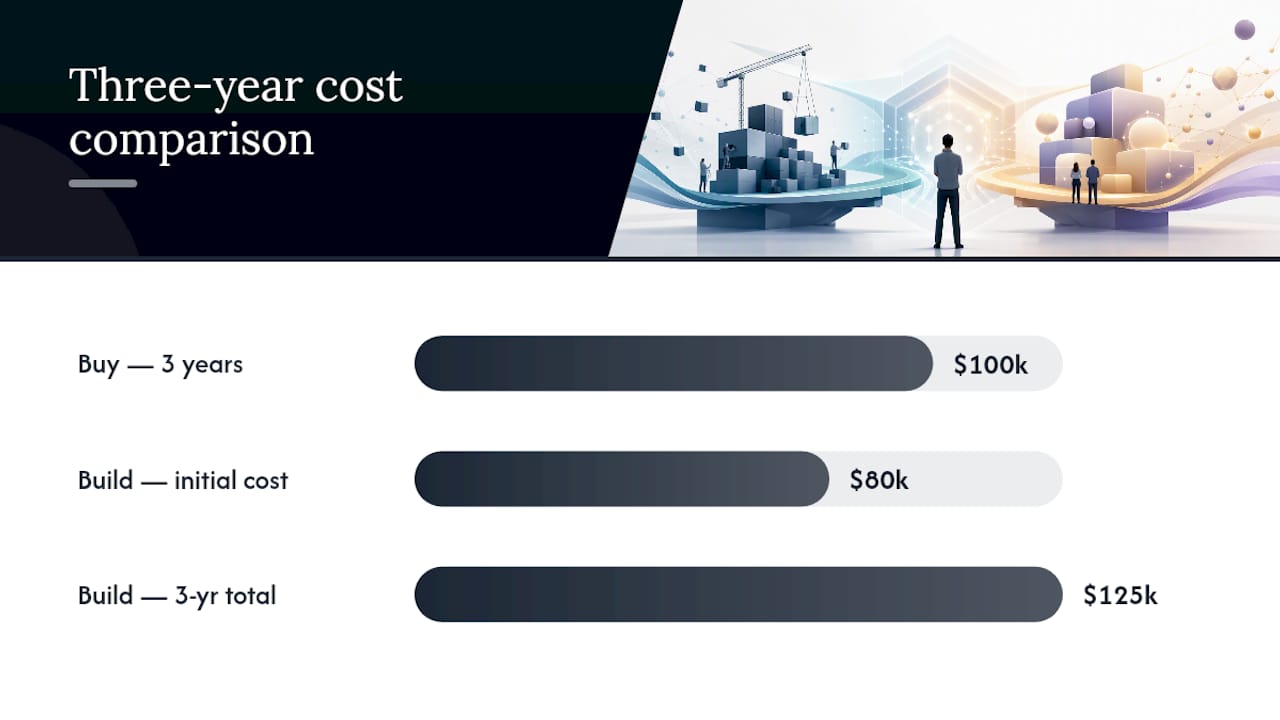
Worked example: a mid-size company estimates a custom internal workflow tool would cost $80,000 to build with AI-assisted development, plus $15,000 a year in maintenance. The closest vendor alternative costs about thirty thousand dollars a year, with renewal increases pushing that higher by year three once AI-tax pricing is factored in. Over three years, buying costs roughly a hundred thousand dollars. Building costs eighty thousand dollars plus maintenance costs, totaling more. On raw numbers, buying wins here, but the break-even point moves fast if the vendor's price keeps climbing at that rate into years four and five, or if your team's AI-assisted development speed cuts that $80,000 build estimate closer to $50,000, which is a realistic range for CRUD and dashboard-style tools today.
Run this model in a spreadsheet, not a mental estimate. Put the vendor's historical renewal increases in one column, your engineering team's real hourly cost in another, and let the break-even year fall out of the math rather than out of whoever argued loudest in the meeting.
How Do You Evaluate Vendor Risk Before You Sign?
Vendor risk is not a single number, it's four separate exposures, and most procurement processes only check one of them.
- Pricing stability. Has this vendor raised prices sharply at past renewals, or bundled new "must-have" tiers that push existing customers up?
- Acquisition risk. A startup vendor with venture funding can get acquired, and the acquiring company may sunset the product or jack up pricing within a year.
- Platform dependence. How hard would it be to migrate off this vendor if you had to? If the answer is "nearly impossible," that dependence itself is a cost.
- Feature gating. Does the vendor hold back capabilities you need behind a higher tier, effectively forcing an upsell down the road?
A short due-diligence checklist surfaces most of this before you sign anything: request the vendor's price history, ask directly about their funding status and runway, test how easily you can export your own data, and read the fine print on which features are "coming soon" versus already gated behind a tier you're not on. Red flags worth walking away from immediately include a vendor unwilling to share pricing history, a contract with no data export clause, or a roadmap that hasn't shipped a meaningful feature in over a year.
Pricing that real vendor risk into your model as an economic adjustment, rather than leaving it as a vague worry, changes decisions more often than people expect. A vendor with high acquisition risk and no data export clause deserves a heavier penalty than a stable, profitable vendor with an open API. That adjustment alone has pushed plenty of "clear buy" decisions into hybrid territory once the real numbers were on the table.
Can You Decide Build vs Buy in 30 Days?
Yes, and you should, because analysis paralysis costs more than a wrong-but-fast decision in most cases. A scoped, time-boxed sprint forces the decision instead of letting it drift for a quarter while three different teams debate it in Slack.
- Week 1: inventory and score. List every stakeholder who touches this workflow, document the current pain points, and run the scoring matrix from earlier in this article as a team, not solo.
- Week 2: spec and shortlist in parallel. Get a rough engineering estimate for a build (ideally using an AI-assisted prototyping pass to see real effort, not a guess), and shortlist two or three vendors that clear your must-have list.
- Week 3: pilot both paths at once. Run a paid or trial pilot with your top vendor candidate while your engineering team builds a thin, working prototype of the core workflow. Neither needs to be production-ready, just real enough to test.
- Week 4: score the pilots and decide. Compare both pilots against cost, time-to-value, and fit to your actual workflow, not the vendor's demo workflow. Write down the decision and the reasoning, because you'll want that record when someone asks in eighteen months why you chose what you chose.
Thirty days is enough time to replace guesswork with evidence, and short enough that nobody's business case goes stale waiting on a verdict.
How AI-Native Platforms Change the Math
Adrianlabs sits directly inside the "build" side of this decision, and it changes what building actually costs. Instead of writing specs and waiting on a sprint calendar, you describe the application in plain language and the platform plans, designs, and codes it in real time, with a live preview instead of a documentation cycle.
A few specific ways this shifts the calculation:
- Time-to-market compresses for internal tools. Workflow automation, dashboards, and admin tools that used to take a sprint or two can move to a working prototype in a fraction of the time.
- Autonomous debugging reduces the ongoing maintenance burden that usually makes building feel riskier than buying.
- Every release is verified for integrity, which matters directly to the vendor-risk math covered earlier: you're not trusting a third party's roadmap, you own the code and the release process.
- Project isolation and code ownership mean the data sovereignty concerns that push some teams toward building in the first place are addressed from day one.
For internal tools and rapid prototyping specifically, this narrows the gap between "buy something that's 80% right" and "build something that's exactly right," without the multi-quarter timeline that used to make building the riskier bet.
What Product Leaders Get Wrong About This Decision
The mistake I see most often isn't choosing build or buy incorrectly. It's skipping the analysis entirely and defaulting to whichever option feels less risky in the moment, which is usually buying, because a signed contract feels safer than an open-ended engineering project.
Three patterns keep showing up. Teams buy for speed without ever modeling the three-year TCO, then get blindsided by renewal pricing. Teams build because their engineers can build, not because the capability is actually core to what makes them competitive. And teams evaluate vendors on feature checklists while ignoring vendor risk entirely, then discover two years in that they're trapped.
Three heuristics cut through most of that noise. If your break-even point on the TCO model lands under 24 months, lean build. And if the capability is genuinely core to your competitive advantage, own it, full stop, regardless of what the spreadsheet says about short-term cost.
Run the 30-day sprint before your next renewal date, not after.
— Adrian
Build Your Own Software Without the Six-Month Timeline
If the framework above pointed you toward build, or hybrid, the next question is how fast you can actually move without hiring a team you don't have budget for yet. Adrianlabs closes that gap: describe the internal tool, workflow automation, or prototype you need in plain language, and the platform handles planning, design, coding, and testing in real time, with a live preview so you see the app take shape as you go.
This fits best for exactly the scenarios this article flagged as build territory: internal tools nobody else needs to maintain, workflow automation specific to how your team actually operates, and rapid prototyping where you need to validate an idea before committing engineering headcount to it. Every release goes through verified integrity checks, and you keep real ownership of the code, whether you run it locally with your own models or use a hosted plan with build credits.
If your scoring matrix pointed toward build, start a project on Adrianlabs and see a working prototype before your next vendor call.
Where the Numbers in This Framework Came From
The scoring matrix and threshold ranges draw on Ardura's CTO decision framework, which lays out the weighted criteria used throughout this article. The AI-productivity figures and subscription-inflation data come from Coommit's AI-era build vs buy analysis. ThoughtWorks' strategic framework whitepaper and the Forbes Technology Council piece both ground the core vs context filter used across the article.
Sources
- Build vs. buy - A strategic framework for evaluating third-party software (ThoughtWorks whitepaper)
- Build vs Buy: Determining Which Approach Is Right For Your Company (Forbes Council)
- Build vs Buy Software: CTO Decision Framework | ARDURA
- Build vs Buy Software 2026: The AI-Era Decision Framework